The Future Advantage May Belong to the Best Loop
What two months of hill-climbing experiments taught me about open models, observable iteration, memory, and recoverable context.
By Vivek Parihar
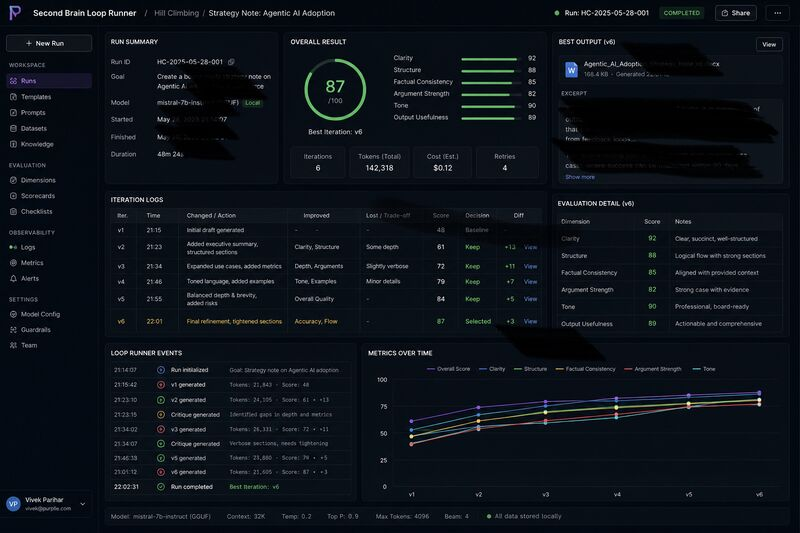
I have been experimenting with hill-climbing loops in my personal Second Brain system for the last two months.
The interesting part is not just the output. I am running this with open models, and with the right loop design, the results are often surprisingly close to what I would expect from frontier models for many knowledge-work tasks.
The real unlock is the loop runner.
Make every iteration observable
Every iteration is logged:
- • What the model changed
- • Why it changed it
- • What it improved
- • Where it lost context
- • What had to be restored
- • Which version actually moved the output forward
That visibility changes everything. Instead of treating the model response as a final answer, the system treats it as one candidate in an optimization loop. It generates, critiques, improves, compares, and retries—while keeping a trace of each decision.
Optimization has trade-offs
When I am building a strategy note, portfolio page, advisory document, or technical thesis, the system does not rewrite only once. It keeps improving across clarity, structure, factual consistency, tone, missing context, argument strength, and output usefulness.
What I found fascinating is how often models “improve” one part while silently weakening another.
- • They may make the language sharper but lose a constraint.
- • They may simplify the structure but remove an important nuance.
- • They may improve flow but dilute the original intent.
The hill-climbing loop helps catch those regressions because every step is observable.
The emerging AI engineering model
For me, this is where AI engineering is moving: not one prompt, not one model, and not one perfect answer—but systems that reason in loops, preserve memory, compare outputs, recover lost context, and improve with traceability.
Open models become much more powerful when surrounded by the right operating system.
“The future advantage may not only belong to the biggest model. It may belong to the best loop.”