LOCAL-FIRST SECOND BRAIN + LOOP ENGINEERING

A Memory System ThatImproves the Work.

A working personal methodology for grounded retrieval, observable iteration, context recovery, and human-approved output.

My Second Brain combines a local knowledge vault with a hill-climbing loop runner. It retrieves relevant decisions and source material, produces a candidate, evaluates it across explicit dimensions, compares the result with the previous version, restores anything important that was lost, and keeps only changes that move the work forward.

DOCUMENTED LOOP RUN
Personal prototype
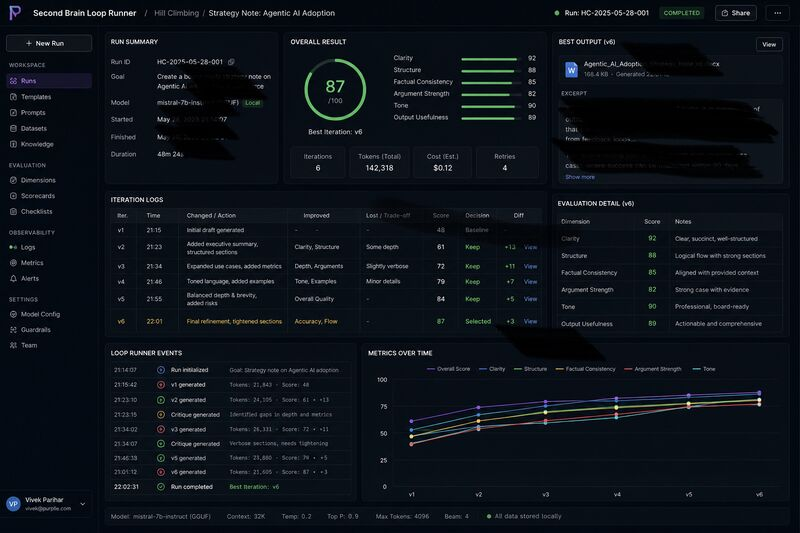
Second Brain loop runner showing versioned iterations, rubric scores, trade-offs, and a selected result
6
Logged iterations
6
Evaluation dimensions
v6
Human-selected result
Local-first
Knowledge and indexes remain controlled
Observable
Every iteration records change and trade-off
Recoverable
Lost context can be restored from prior versions
Human-gated
Final decisions remain accountable
SYSTEM STATUS

What is working, what is demonstrated, and what is not claimed.

Working methodology

  • Local document organization and indexing
  • Context retrieval and structured prompt assembly
  • Versioned candidate generation
  • Rubric scoring, comparison, and iteration logs
  • Context-loss detection and restoration
  • Human selection of the final version

Public demonstration

  • Sanitized repository structure
  • Fixed replay of a documented strategy-note run
  • Public-safe evaluation dimensions and trade-offs
  • Representative local commands and workflow stages

Not claimed

  • Universal accuracy or zero hallucinations
  • Autonomous publishing without human review
  • Formal SOC 2, GDPR, or enterprise compliance certification
  • A public production service or downloadable product
WORKING METHODOLOGY

Memory supplies context. The loop supplies improvement.

A useful Second Brain needs two connected systems: a memory path that retrieves grounded context and an optimization path that can improve output without silently dropping intent.

Stage 1 of 8

Capture

Files remain human-readable and organized by domain. Each item carries enough metadata to trace its origin, recency, project, and intended use.

Observable artifact
vault/{notes, decisions, projects, clients}
IMPLEMENTATION SHAPE

The working directory separates control, knowledge, retrieval, data, and run history.

The first four areas reflect the repository structure demonstrated on the live implementation. The run-history folder is the loop-engineering extension that makes improvement observable and recoverable.

second-brain/
Directory detail

.brain/

Control plane

Reusable commands, agent configuration, hooks, guardrails, evaluation rules, and output contracts.

commands/proposal.md
commands/brief.md
hooks/
agents.json
evaluation-rubric.json
PUBLIC-SAFE RUN REPLAY

A strategy note improved through six observable iterations.

This fixed replay reflects the working methodology described in my loop essay. It demonstrates how changes and regressions are recorded. The rubric scores belong to this single documented run; they are not general model benchmarks.

Run
HC-2025-05-28-001
Model
Local open model
Iterations
6
Selected
v6
Goal
Create a concise strategy note on agentic AI adoption.
Iteration history
Selected iteration

v6 / 87

Selected · +3
Changed

Tightened the final sections and restored missing nuance.

Improved

Accuracy, flow, and completeness.

Lost / trade-off

Marginal gain indicated convergence.

Selected-version evaluation
Clarity92
Structure88
Factual consistency85
Argument strength82
Tone90
Output usefulness89
STOPPING AND SAFETY RULES

The loop is useful because it is bounded.

Must-keep constraints

A candidate is rejected if it drops a required fact, source boundary, audience need, or explicit instruction—even when its total score rises.

Independent dimensions

Clarity cannot compensate for factual inconsistency. Each critical dimension has its own threshold and regression check.

Versioned recovery

Every candidate, diff, scorecard, and decision remains available so the system can restore the last known good state.

Iteration budget

The run stops when improvement becomes marginal, a quality target is met, or the allowed time, token, or cost budget is exhausted.

Source traceability

Retrieved context keeps its file reference. Unsupported claims are flagged for review rather than converted into confident prose.

Human approval

The loop can recommend a candidate. A person remains accountable for sensitive decisions, publication, and external action.

WORKING APPLICATIONS

Where this methodology creates practical leverage.

Strategy Notes

Retrieve prior theses and decisions, improve the argument over multiple iterations, and keep a visible record of what changed.

Research Synthesis

Connect material across sources, preserve disagreement, flag evidence gaps, and separate cited fact from interpretation.

Portfolio and Page Copy

Improve clarity, structure, tone, and claim discipline while protecting the original positioning and constraints.

Advisory Documents

Turn notes into decision-ready briefs while retaining risks, assumptions, alternatives, and accountable next actions.

Architecture Decisions

Recover earlier trade-offs and design rationale before evaluating a new option or writing an ADR.

Recurring Updates

Synthesize recent logs into status updates while preserving continuity across weeks and projects.

METHOD IN PRACTICE

A minimum viable loop can start small.

01

Define one repeatable task

Choose a strategy note, research synthesis, proposal, brief, or weekly update with a clear definition of good.

02

Create a trusted source set

Place human-readable material in the vault and distinguish source documents from generated artifacts.

03

Index with provenance

Chunk and embed locally while preserving file path, timestamps, project metadata, and stable source identifiers.

04

Write the rubric before the loop

Define quality dimensions, must-keep constraints, failure conditions, and the stopping budget before generation begins.

05

Log every candidate and decision

Store the prompt, retrieved context references, output, scorecard, diff, trade-offs, and keep-or-retry decision.

06

Review before use

Treat the selected result as a reviewed artifact—not an autonomous truth or an unbounded action.

The advantage is not memory alone. It is memory connected to an observable improvement loop.

This is an evolving personal methodology for building better knowledge work with local context, explicit evaluation, recoverable versions, and human judgment.

KNOWLEDGE SYSTEMS

Discuss a grounded knowledge or evaluation methodology.

For conversations about local-first memory, retrieval quality, evaluation loops, and human-controlled AI workflows.